Do The Right Thing
Good institutions aren’t sufficient. They work for everyone only if unrecognized, everyday heroes make them work.

This essay is likely too long for an email. Please double-click on the title to read it on the Substack site.
The main proposition here is that “the rule of law” only works if a critical mass of people in the system actively choose to do the right thing when their number gets called. Success is a choice. The great tragedy is that we can’t deterministically program success. Failure is also a choice, and we have abundant historical examples of societies choosing failure. Choosing to do the right thing, in both small and grand ways, amounts to lubricating the mechanisms of governance and tightening loose screws when and where one finds them.
On paper, we can design the best rules, the best processes, the best constitutions, the best mechanisms. We even have theories of “mechanism design” in our literatures on why and how institutions matter. But we can yet end up with arbitrary rule and institutional sclerosis. The system only works if a critical mass of people in positions of authority as well as people subjected to that authority make a point of making the system work for everyone.
Why? Because, we can’t deterministically program people to do the right thing. Rather, opportunities to choose between doing the right thing and committing grievous mischief will arise. There is no “complete [social] contract” that will cover all contingencies. Any given crisis may inspire a lot of (possibly messy) process, and as messy processes unfold, those in leadership may find themselves gifted the option of “never letting a crisis go to waste.” And what will the leadership choose? Will those in leadership choose to exploit a given matter for personal gain? Will they choose to chip away at the integrity of the system? Worse, will those in leadership even choose to manufacture crises? Alternatively, would the people in leadership find their inner Cincinnatis (plural) and do the right thing? What may constitute the right thing in any given instance might not be entirely obvious, but would the leadership, at least, endeavor to restore the integrity of the system?
Manufacturing crises from within the system is one thing. External threats are another. Programs concentrating on globalized governance present external threats.
Globalists are globalists, because they endeavor to establish centralized, global governance. It turns out, however, that there is some number of (sometimes competing) globalist programs. Islamists, for example, endeavor to subject the whole of human society to Sharia. Hence calls to “Globalize the Intifada!” They’ve been fitfully pursuing this program since the 7th century. Meanwhile, the Colectivos of places like Venezuela and Cuba remain part of the larger on-and-off program started in the early 20th century to subject the world to global, communist governance. Then there is the Neo-Liberal program—or, depending on who you are reading, the Neo-Con program—of sweeping away national boundaries and subjecting the world to a global “rules-based order.”
* * *
This essay was inspired by evidence of mounting external threats to the United States. That’s a big statement. But, first, a confession: I was deeply gratified to wake up on the morning of Saturday, January 3, 2026 to learn that American forces had managed to sweep into Caracas and surgically extract Venezuelan bad guy Nicolás Maduro.
This confession is important, because many of my essays concern arbitrary governance (the stuff of Realpolitik) and its principal remedy, the rule of law. So, how can I align with an act that seems so arbitrary? The reason is that you may not be interested in Realpolitik, but Realpolitik is deeply interested in you.
Each of us will have to choose a side. If everyone were committed to playing by the rules of the game, then we would be spared the matter of choosing. But, everyone isn’t. In fact, many factions out there may strategically appeal to “the rule of law” or a “rules-based order” or “international law” when it suits their purposes, but they will blithely ignore these things when otherwise making an ostentatious show of honoring them no longer suits their purposes. These people really doth protest too much in that their behaviors align with something worse than mere lawlessness. Their behaviors and preferences align with governing under the “color of law”: arbitrary governance while pretending, like Obama operative Susan Rice, to operate “by the book.”
In this essay, I make contact with two reflections on arbitrary governance. One of these reflections involves content I have periodically discussed, but the second installment is new (to me): Marc Bloch’s reflection in Strange Defeat (1940) on the spectacular failure of the French to hold up the German invasion in May 1940.
On my reading, Strange Defeat makes contact with an enduring problem: It is one thing to design (intendedly) optimal rules, but the universe really does have a way of making out the technocratic conceit of optimal design as just that: a conceit. A familiar rules-versus-discretion tradeoff obtains, and it’s the kind of thing some business school professors have carried on about (and should carry on about) in different guises: how do we enable people to optimally sweep in and deviate from the rules when deviating from the rules makes sense? But, once we make some provision for some party to break rules, are we not creating opportunities for affirmatively destructive deviations from the rules? Are we not creating some scope for arbitrary governance?
Stated differently: Might there not be some optimal level of rule-breaking arbitrariness? Can we design rules in the spirit of a pressure-release valves that enable that optimal level of arbitrariness? But, would that optimal level of arbitrariness yet require us to put up with some volume of the arbitrariness that we had hoped to contain? How do we screen out the bad and channel the good? Can we only manage to screen out some of the bad stuff? Do we have to put up with some volume of “false positives” (deviations from rules that are accepted as good when, in fact, they’re bad) and “false negatives” (failures to deviate when deviating would make sense)?
Let me start with Yasunari Kawabata’s The Master of Go (1951).
Kawabata used the governance of Go tournaments as a metaphor for rules-versus-discretion tradeoffs. Japan had just emerged, shattered, from the Second World War. Through the course of the Occupation (1945-1952), the Americans had a strong hand in implementing formal democratic processes in Japanese government.
Democracy! Sounds good, dun-nit? Kawabata explicitly identified democratic process with rules-based governance. Rules would ostensibly contain arbitrary governance, and it was broadly understood, after all, that it was a lot arbitrary governance through the course of the 1930’s, that had led Japan down the path to conflict with (first) China and then Britain and the United States. Conflict inspired an effort to cocoon the Japanese islands within a “Greater East Asia Co-Prosperity Sphere” spanning much of East Asia, Southeast Asia and the Western Pacific. The program started off with spectacular military successes but ultimately inspired a slow-rolling yet inexorable response from both Britain and the United States. That response rose up gently at first, like a tsunami sweeping almost imperceptibly across the seas before monstrously cresting and crashing down on Japan’s shores. The United States crushed Japan’s capacity to project power and pulverized any number of its cities.
Kawabata goes on to observe, almost in passing, that the effort to supplant the old way of doing things—a way that assigned much weight to discretion exercised by those of superior “age and rank”—did come at some cost. A deficiency of the book (in my estimation) is that he did not elaborate on how that cost became manifest. My sense is that the old way of doing things did, in fact, impose a lot of strict rules… on people not endowed with the privileges attending age and rank. But the old ways did afford those invested with age and rank with much capacity to exercise discretion.
This is a very Confucian thing: The exercise of discretion is very hierarchical in that it is up to subordinates to fall in line and implement orders from above, although it is up to superiors to look after the well-being of subordinates.
How “banzai charges” and kamikaze attacks factor into the well-being of subordinates is a question. Further, one can imagine superiors sometimes failing to do the right thing and exploiting their place high up in the hierarchy and imposing arbitrary demands on subordinates. At the same time, however, someone somewhere in any hierarchy has to make decisions and craft adaptations when plans don’t unfold on schedule. Someone may have to do something that appears arbitrary, and, indeed, some degree of apparent arbitrariness will be something we should have to factor into our thinking about how hierarchy could be made to work.
I would pose the avoidable loss of life attending the sinking of the South Korean vessel Sewol in 2014 as an example of how a hierarchy failed to work, because no one in the hierarchy chose to break protocol and do the right thing. An overloaded, poorly loaded, and top-heavy ferry en route from Incheon, South Korea to Jeju-do (a volcanic, almost-tropical island south of the Korean peninsula) made a hard turn in the narrow waters of the Maenggol Channel. Cargoes ended up sliding to one side of the ship, and it began slowly to list. Passengers were instructed to remain in their cabins, but no one thought to direct passengers to leave their cabins even as the list began to exceed 45%. The captain and crew managed to jump ship, but no one in the crew bothered to countermand the order to restrict passengers to their cabins, and few (if any) passengers bothered to exercise initiative of their own and leave their cabins.
More than 300 passengers went down with the ship, with most of them in their cabins awaiting further instruction, all because no one could bear the psychic cost of breaking protocol. None of the crew and few, if any, of the passengers had the presence of mind to Do the Right Thing: exercise some leadership, and lead passengers to the upper decks where they might at least have had some chance of getting off the ship and surviving. The ship ultimately capsized.
On my reading, the great innovation of the new rules-based governance in post-war Japan was to impose more rules on those operating at the top of Japanese hierarchies—that is, on people of age and rank who had formerly been able to exercise much discretion. Instead of a Council of Elders getting together and deciding, “Let’s invade Korea,” the proposal to do such a thing would have to go through formal (rather than informal) committee processes and might not ever make it out on to the floor of a deliberative body for a vote. (Would Hideyoshi’s invasion of Korea in 1592 have made it out of committee?)

Under the old ways, the Council of Elders would informally come up with a program, and it would be up to everyone populating the machinery lower down in the hierarchy to get on with it. Under the new, democratic, rules-based way of doing things, big proposals like “Let’s build a nuclear deterrent,” might never go anywhere. Even so, decision-making capacity (and the exercise of discretion that goes with it), does not entirely disappear. What comes of it?
My sense is that much decision-making capacity and discretion moves from the metaphorical Council of Elders and gets buried from sight in new administrative agencies. Kawabata does not make explicit contact with administrative agencies, but he does make a very important observation relevant to the conduct of administrative agencies: Rules can enable something worse than explicit exercises in arbitrary governance. They can enable arbitrariness exercised under the color of law—that is, people in authority could rule arbitrarily while pretending to abide by the democratic, rules-based order.
We end up having to do something of a “comparative institutional analysis.” The old ways will have had their advantages, but they could also enable a small clique of fanatics to fall into Groupthink and lead the country into disastrous projects like “Invade Manchuria” or (in the German case) “Invade the Soviet Union.” Ostensibly rules-based governance might diminish the capacity of small cliques to concentrate the resources of the entire country on crazed projects, but, as Kawabata observes, “When a law is made, the cunning that finds loopholes goes to work.” That cunning becomes manifest as “a slyness which, when rules are written to prevent slyness, makes use of the rules themselves.” Further, what happens when there really is an emerging threat and someone needs to make some heavy decisions?
On heavy, pressing decisions, let me return to Marc Bloch’s Strange Defeat (1940).
Marc Bloch was a veteran of the First World War and found himself volunteering his services again for the Second World War. After the Fall of France, he ended up assuming important leadership in the French Resistance.
He ended up being hunted down and executed for his potent efforts. But, before the Gestapo could get around to that, he managed to put down his own thoughts on the organizational failures of the French military. These failures went some way toward enabling the German blitzkrieg of May 1940 to be such a success that even Hitler and the Nazi leadership were astonished.
On my reading, Bloch makes the point that (1) you can institute the best plans and the best processes, but that may amount to very little unless you have people who are committed to making the processes work. You need a host of Cincinnatis, both high up in a hierarchy and low down in the hierarchy, to make things work.
That said, (2) your processes might not be optimal. They might not conform to “best practices.” It’s hard to know. It’s easier to prepare for “the last war” (World War I) than to be able to anticipate the innovations (yet to be witnessed) in the forthcoming conflict (World War II).
That said, (3) one can anticipate that demands to adapt will make themselves manifest. As Professor of Organizational Economics Mike Tyson has observed, everyone has an optimal plan until he gets punched in the face. So, anticipating a metaphorical punch in the face, should we not impose some demands and expectation on ourselves to be adaptable? But how do we collectively decide when to break the from the finely-tuned, hyper-optimized rules, break from hierarchy and enable parties anywhere in the hierarchy to adapt?
Tricky questions, and if it were all so easy, then we wouldn’t need to study how to enable efficient adaptation. But, Bloch seems to suggest that the French military was so stuck in over-engineered hierarchical sclerosis masked as progressive, hyper-rationalized, scientifique solutions that the question of ever having to anticipate deviations from a rigid script never attracted the attention and mental energy it deserved. (The mirage of hyper-rationality is the subject of a very nice essay by Gary Saul Morson, “The Greatest of all Novels,” The New Criterion, March 2019.)
Bloch found himself in a position of some authority somewhere in the middle of the hierarchy. He had a hand in coordinating the logistics of fuel supply. It did occur to him that merely rolling out a map and setting up a static network of fuel depots might not amount to an adequate effort to address the dynamic problem of defending the country. It could be the case that, once hostilities got going, advancing French forces would require supplies to keep up with them. So, how should they anticipate uncertain demands to extend supply lines beyond the French (or Belgian) frontiers into Germany itself? Of course, it could also be the case that French forces could find themselves retreating in a particular sector. Should the logistics team then come up with plans for denying advancing German forces access to fuel? Further, should the logistics team invest in greater capacity to communicate with team members and with active forces across a dynamic, changing battlefield?
Bloch found himself breaking with protocol (a very big deal) in his own effort to make the logistics of fuel supply a little more flexible and adaptable. He had a contact in “a small neutral country about an equal distance from the French and German frontiers” (Luxembourg?) The contact operated a fuel dump and posed to Bloch the prospect of topping off fuel supplies in anticipation of French forces requiring them. Alternatively, should he allow supplies to dissipate to peace-time levels in anticipation of the Germans rushing in and securing them? Bloch took the decision himself and advised to keep supplies low. He was not confident that the French would manage an effective advance; better to deny the Germans access. He broke protocol and unilaterally made the decision, because he was also not confident that his senior leadership would get around to addressing the matter before the bullets started to fly. He proved to be correct.
On this last point, Bloch reveals something of the brittleness of the French strategy. The strategy was very defensive and seemed to involve waiting for the Germans to come to them and to then envelop the enemy and annihilate it—or at least, drive it back—by sheer mass of arms. All well and good, and perhaps the strategy could have worked, but the blitzkrieg really did operate so quickly that French decision-makers were never equipped to know what was going on and where to attempt any effort to envelop the enemy. Communication lines were brittle (and thus susceptible to disruption) and, no less importantly, parties on the front line had been neither trained nor instructed to exercise discretion. They were stuck depending on leadership from the top of the hierarchy, but the top leadership was so out of touch as to be worse than useless.
Contrast the French over-reliance on rules and hierarchy with the German approach. In Bloch’s telling, the Germans literally demonstrated a much more “democratic” approach to decision-making. (Kawabata identified “democracy” with rules being applied up and down a hierarchy. Bloch identified “democracy,” in this case, with rule-breaking far down the hierarchy.) The Germans came into the fight with a broadly-held appreciation of the fact that best-laid-plans have a way of blowing up on encounters with reality, and the personnel on the front line in the immediate line of fire need to have some capacity to extemporize. Senior leadership gave personnel on the ground the capacity to choose to do the right thing.
But, giving people license to extemporize can also be problematic. One person’s extemporization may be another person’s failure to exercise initiative. “Yes, we ignored orders to take the high ground, Because Reasons [and our failure to advance messed up the entire army’s advance, and here we all are stuck in a trench and surrounded].” (The American failure to take the Alban Hills above Anzio, Italy in 1944 comes to mind.) Or, extemporizing may work: “We ignored orders to hold up and wait for supplies to catch up, because we wanted to take the high ground before the enemy showed up. [Our gamble worked, and we managed to hold the enemy off when it finally did show up.]” (Guderian’s and Rommel’s romp through France in May 1940 looks like a prime example.) Or, extemporizing may have made for an inspired idea, but things didn’t quite work out: “Our gamble to take the high ground did not work, because, while we did get there, reinforcements and supplies were too slow to catch up. So, here we are surrounded.” (The opening days of the Gallipoli experience in 1915 seems apposite.)
It is true that being something of a maverick and exercising initiative without approval from higher up in the hierarchy will result in some failures. But, the French, in Bloch’s estimation, were very poorly equipped to even contemplate on-the-ground adaptations. It got worse, and this is the most important point that Bloch makes: Best-laid, hyper-optimized plans are great, but stuff can still break down if your people do not share an esprit de corps and thus end up less than completely committed to doing what it takes to make stuff work. The Germans had it. The French didn’t.
Interesting, no? In Japan, democratization involved saddling the top of the hierarchy with rules, in which case real, discretionary decision-making capacity migrated, for better and for worse, to the administrative agencies. In the Battle of France, the Original Nazi Gangstas democratized battlefield decision-making by granting their people far down the hierarchy much license to exercise discretion. But, those people were committed to the mission, so they actually performed well rather than choosing to shirk their duties and shift burdens to other units. And note what commitment involved. It involved senior leadership not lining up and shooting junior leadership for taking risks, especially when a given initiative failed to pan out, and it involved junior leadership knowing it had license to be aggressive and then doing a good job of deciding when and where to take risks.
* * *
Did Donald Trump do the right thing in apprehending Nicolás Maduro?
Millions of Venezuelan emigres around the world demonstrably think so, although the project of restoring something that looks like democratic governance in Venezuela will involve a lot more, surely, than just “decapitating” the leadership of a narco-state. That said, the usual suspects have lined up to criticize the move: It deviates from “international law.” It sets a precedent for sweeping in and nabbing countries and amounts to granting license to China to nab Taiwan. It gives cover to Putin and the Russian invasion of Ukraine. The action amounts to the start of another “forever war.” The Just-asking-questions-Brigade, both of them, reliably piped in: Candace Owens suggests that “Zionists” have something to do with it. (The Libertarians have done the same thing: “Maduro’s Kidnapping is Part of a Larger Zionist Operation.”) Then, on the X platform, Russia Today (@RT_com) posted a clip of Tucker Carlson suggesting that a motivation for the apprehension of Maduro is a campaign to institute the “Globo-Homo” agenda (“gay marriage,” “transgenderism”) in Venezuela. Venezuela isn’t gay enough. It all makes sense now; Thank you Tucker …
My focus is on the bit about “international law” and “forever war,” although let me note that the Russians and the Chinese rank among the most vociferous critics of the American action. If the apprehension of Maduro really does give Russia and China license to do whatever they want to do, then one might have expected them to quietly approve. Why do they affirmatively not approve? Do they privately approve but publicly disapprove?
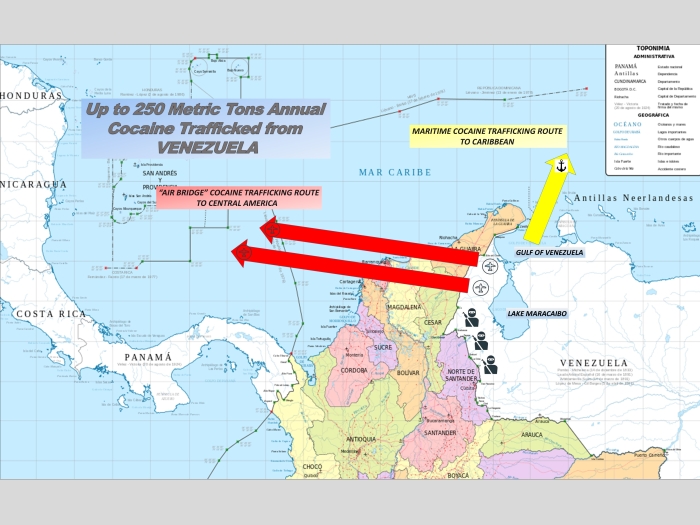
Anyway, it is hard for me to document exactly what has been going on in Venezuela, but we have been hearing for years that Venezuela has been an important node in a network involving illicit commerce in oil and drugs. Some of the oil has kept Cuba on life support, although electricity in Cuba has been available only hours a day the last few months. Hours a day may soon diminish to far less than that, and one can wonder what will come of the Cuban leadership.
The apprehension of Maduro follows a months-long campaign of destroying drug-running boats in the Caribbean and a more recent campaign of seizing oil tankers. The campaign has also involved the impressive concentration of naval forces in the Caribbean. Why all of the military force? Is it part of an invasion bluff, and bluffing might induce certain factions in Venezuela to cooperate? Or, do you really need many of those vessels to police a blockade?
It turns out that federal indictments for a host of regime personnel, including Maduro himself, had been filed in the Southern District of New York way back in 2020. (This is the infamous S.D.N.Y through which the Democrats have waged war on Trump since at least 2020.) It also turns out that the Biden Administration had put out a $25 million bounty on Maduro’s head on January 25, 2025, just days before the inauguration of Donald Trump to his second term. From the self-anointed “paper of record,” The New York Times:
The Biden administration said on Friday that it was offering $25 million for information leading to the arrest of Nicolás Maduro, the president of Venezuela, after he assumed a third term in office despite evidence suggesting that he lost Venezuela’s recent election.
The announcement was a retaliatory measure by Washington, which does not recognize Mr. Maduro as the rightful president of Venezuela. Mr. Maduro has presented no evidence that he won a July election, while his opponent Edmundo González has presented thousands of publicly available vote tallies that he says indicate he easily won the most votes.
The United States has said that Mr. González is the president-elect of Venezuela and has urged Mr. Maduro to step aside…
In 2020 Mr. Maduro was indicted in the United States, accused in a decades-long narco-terrorism and international cocaine trafficking conspiracy.
You can read the indictments here, including the one specific to Maduro.
Maybe going after Maduro and his people is like going after Al Capone for tax evasion:
Al Capone
In the “roaring twenties,” Al Capone ruled an empire of crime in the Windy City [Chicago]: gambling, prostitution, bootlegging, bribery, narcotics trafficking, robbery, “protection” rackets, and murder. And it seemed that law enforcement couldn’t touch him.
The early Bureau [FBI] would have been happy to join the fight to take Capone down. But we needed a federal crime to hang our case on—and the evidence to back it up. Eventually, that day would come…
On June 16, 1931, Al Capone pled guilty to tax evasion and prohibition charges.
The ultimate objective in Venezuela may have little to do with either oil or drugs and a lot more to do with ridding Venezuela of Chinese, Russian, Iranian and Cuban influence. On that count, I note that the Cubans report that 32 of their people perished in the operation to apprehend Maduro. The Cubans were providing Maduro with security. Interesting, no? Like, why are Cubans providing ample security for Venezuelan officials? Got to protect those streams of oil without which their country goes permanently into the dark.
Here’s an image from the press release of March 26, 2020 attending the 2020 indictment:
Meanwhile, here is presidential candidate Joe Biden castigating the Trump administration in 2020 for not going after Maduro:

The forever war in Venezuela lasted about four hours. The US military stopped the stopwatch at about 4 am Caracas time on the morning of Saturday, January 3. So, to the protesters of the day after who demanded that we “stop the bombing”: You missed the bus on that one. We will yet see how things unfold going forward, but, the exercise of that Saturday morning amounts to the end of modest displays of pyrotechnics. Surely anyone underneath that stuff experienced “shock and awe,” but the exercise was vanishingly small compared to the exercise in shock-and-awe that Donald Rumsfeld had a hand in organizing in Iraq in 2003. Trump ain’t no Rumsfeld. Rumsfeld ain’t no Trump.
Now, some protesters will have appealed to an elusive “international law” on this matter. Let me suggest to the reader in John Lennon fashion that we imagine what international law would look like… I am thinking that national borders will have dissolved. We’d be subject to the rule of technocrats cloistered in New York and Geneva. There’d be no war, because the rules-based order would iron out regional disputes.
In fact, that invites an interesting question: If “our rules-based order” already prevails, why is there any war, anywhere, ever? And, given there is a lot of war going on, doesn’t it mean that some party has contravened the global order and is therefore an outlaw who has committed crimes against humanity?
There is more: The usual suspects claim that only Congress maintains the constitutional authority to “declare war,” and therefore Trump Bad. I note, however, that Congress has not formally declared war since June 4, 1942 when it declared war against—wait for it!—Bulgaria, Hungary and Romania. (These countries had allied themselves with Nazi Germany.) The United States had declared war on Japan on December 8, 1941 but still remained nominally neutral with respect to the war in Europe up to that time. To the great puzzlement of Hitler’s generals, Germany went ahead and declared war on the United States on December 11, 1941. It was only later that day that the United States formally gave up the fiction of neutrality and reciprocated with a declaration of war on Germany.
Since 1942, the United States has fought major wars in Korea (1950-1952), Vietnam (1965-1973) and Iraq (1991). Throw in the “nation-building” fiascos in Iraq (2003-2021) and Afghanistan (2002-2021). Then there are the various interventions, replete with bombing campaigns, in Serbia, Syria and Libya. “We came, we saw, he died!” Hillary Clinton joked with respect to the killing of Muammar Qaddafi in Libya. No one complained.
Engaging military force is a serious business, but it is not obvious that a formal declaration of war has ever amounted to more than rhetoric. The Executive branch of government has availed itself of constitutionally-consistent processes for engaging military force, although Congress has sometimes endeavored to impose more structure and limits on the Executive’s capacity to wage war. (See, for example, the War Powers Act of 1973, the constitutionality of which is itself an enduring subject of debate.)
One view of what is going on—a view that I think imposes much needed structure—is the view that the current Executive has made a point of seriously recognizing the new “Great Powers” competition. An important aspect of recognizing this new reality is reinvigorating the Monroe Doctrine. The Monroe Doctrine goes back to the early Republic. It put the (European) powers of the time on notice that meddling in affairs in America’s back yard would invite scrutiny from the young Republic, and that scrutiny could turn into offensive action. So, think carefully before meddling.
The French decided to meddle in the 1860’s when the United States was distracted, dissipating its prodigious energies in the American Civil War (1861-1865). The French invaded Mexico in 1861 and elevated Archduke Maximilian of Austria to leadership. The French withdrew in 1867 under American pressure. The Mexican Republican forces subsequently captured the self-proclaimed Emperor Maximilian I of Mexico and executed him by firing squad. The films Major Dundee (with Charlton Heston, 1965) and Two Mules for Sister Sara (with Clint Eastwood and Shirley MacLaine, 1970) make heavy contact with the French occupation of Mexico.
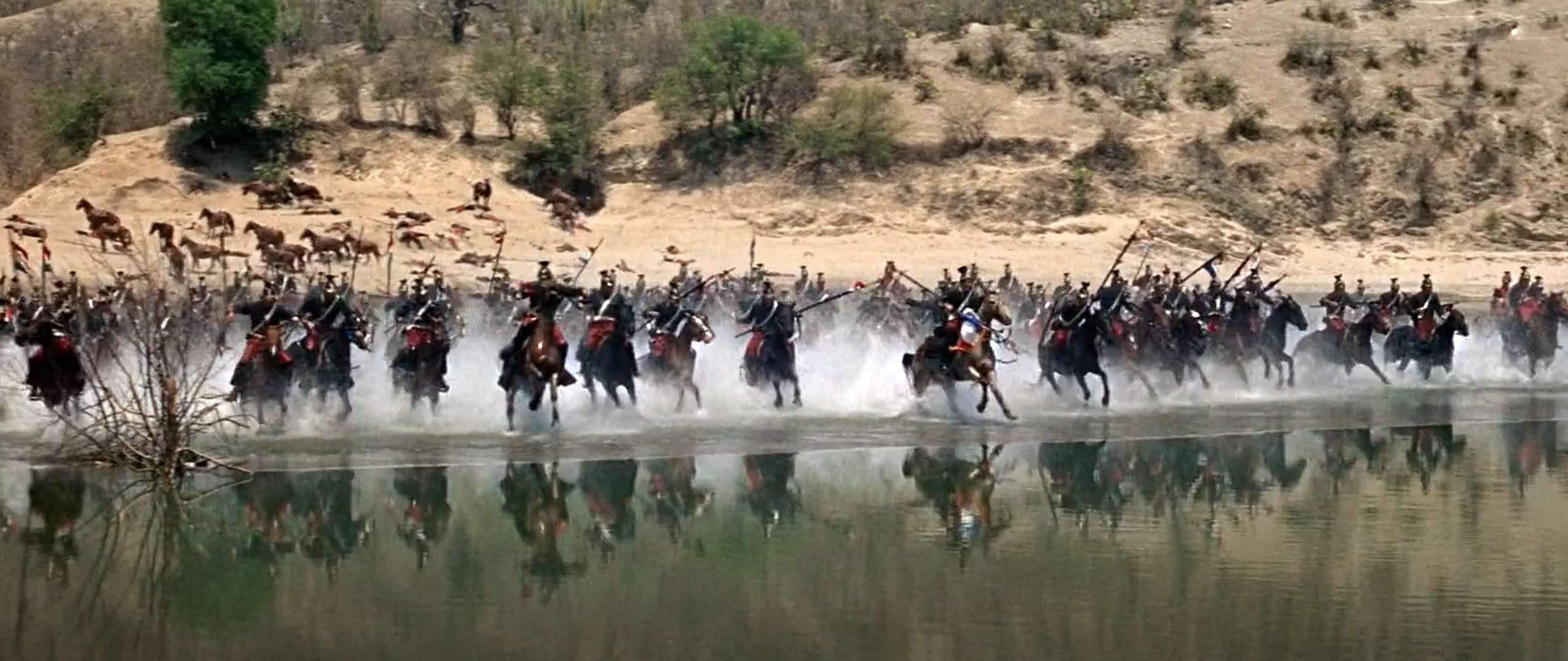
That is a such a beautiful scene, the French charging across the Rio Grande …
Anyway… I lost my train of thought …
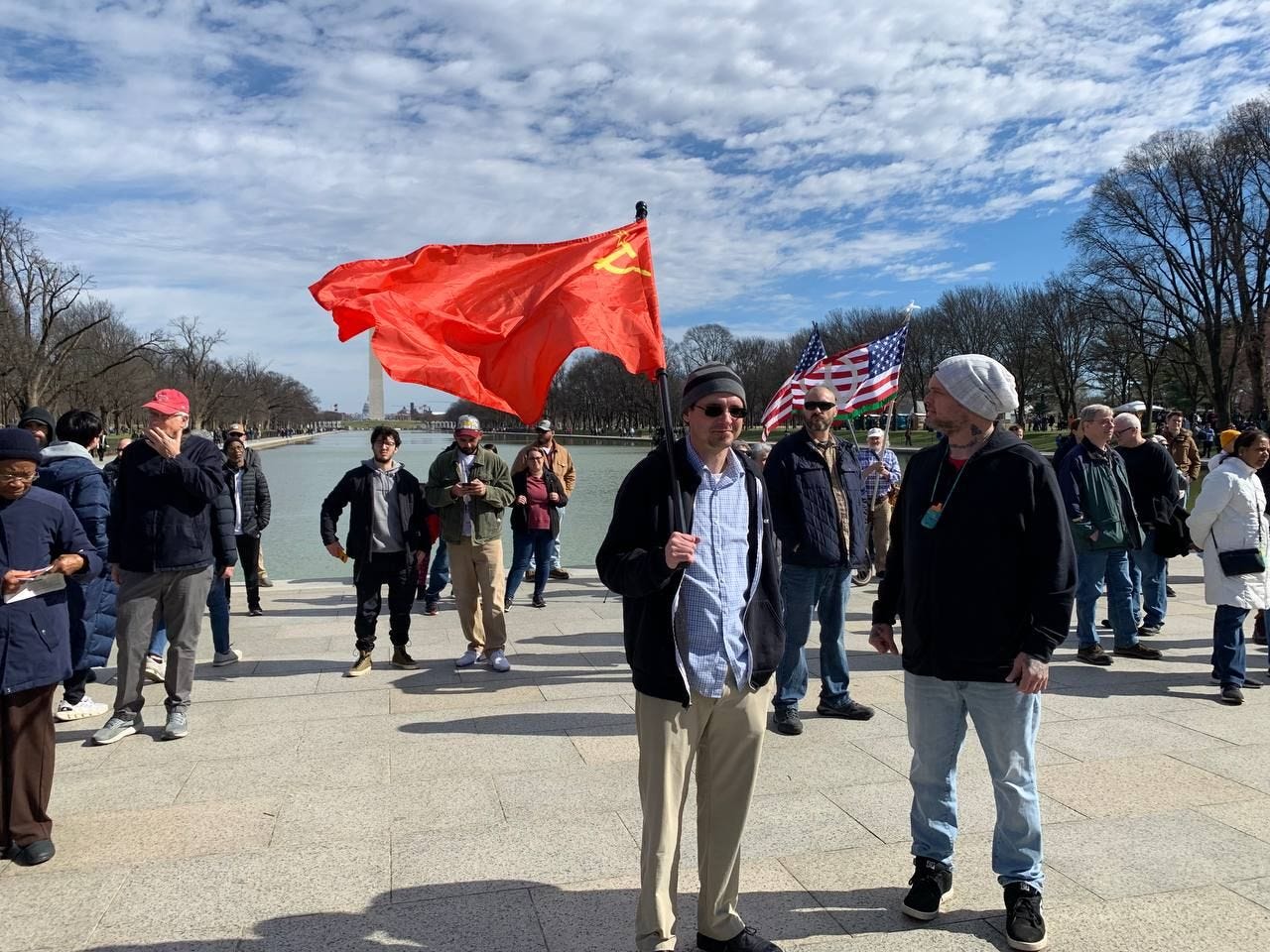
Here we go: A few years ago, I attended a “peace rally” on the National Mall, right there in front of the Lincoln Memorial. In these pages I posed the question in the spirit of “Are Left and Right coming together over the war in Ukraine?” I posed reasons why that might be the case. Might.
Here are two scenes from the “peace rally”:

Since then, I’ve revisited (in these same pages) reasons why that is affirmatively not the case. And, for a long time, I’ve puzzled about a simple way of explaining what is really going on. So, here we go, a hyper-simplified hypothesis. The thrust of this exercise is The Matrix:
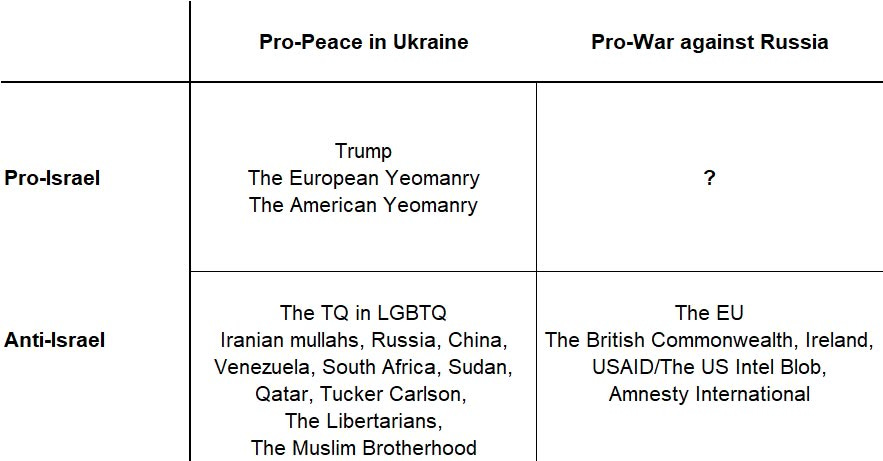
Note that “Pro-Israel” might as well be “Pro-America” or “Pro-Western Civilization,” even with all the “globo-homo” stuff thrown in. “Anti-Israel” would conform to “Anti-America,” “Never-Trump,” and “Anti-Western Civilization.”
So, what I am suggesting here? That “peace rally” I attended in 2023 wasn’t about peace. It was about “pro-Russia” (about which I have no problem, per se) and “anti-West” (about which I have a lot problems). For most of the protesters there, the issue wasn’t peace and prosperity for all. It was just an excuse for an expression of anti-Western sentiment. So, no. Left and Right were not coming together over Ukraine. A syphilitic, anti-Westernism was being celebrated.
What else? The fact that globalists adhere to a rabid anti-Putinism separates them from the other anti-Western factions, but the European leadership is (oddly) deeply anti-European. How else to explain the industrial importation of peoples from North Africa, East Africa, the Middle East and the Hindu Kush who demonstrate no respect for “doing the right thing” as measured by liberal democratic norms?
It is hard not to conclude that the pro-Maduro crowd is virtually identical to the anti-Israel crowd, and that crowd largely conforms to the anti-America crowd and anti-West crowd. None of these people care one whit for institutional integrity or “the rule of law.” They might strategically appeal to those things, but those strategic appeals are no more than that: strategic but disingenuous appeals to things they don’t believe in. Because they have to tear down the West. “Western Civ has got to go!” And, “Globalize the Intifada.” Believe them when they tell you who they are.