Operationalizing Voting Rights
The point of racial gerrymandering is power and political monopoly, not democratic representation.

Gerrymandering and the Voting Rights Act of 1965 have been much in the news the last few weeks. What is going on?
Let me open with a thumbnail sketch of post-Civil War history:
The Civil War ended in 1865. The 13th Amendment to the Constitution (ratified in 1865) abolished slavery. The point of the 14th Amendment (1868) was to neutralize the prospect that the authorities in the former slave states might find legalistic ways to deny former slaves full citizenship. The 15th Amendment (1870) imposed more structure by declaring that no citizens could be denied their rights to vote “on account of race, color, or previous condition of servitude.” (Some citizens, such as convicts, might yet be denied voting rights.) Further, Congress could come up with legislation were enforcement of the 15th Amendment to prove to be an issue.
Vigorous political competition did emerge in the former slave-holding states of the South, but, enforcement did start to become an issue. Through the course of the 1880’s, Southern states did manage to frustrate access to voting by implementing various mechanisms such as poll taxes or literacy tests. By the 1890’s, the legalistic mechanisms of what we would come to recognize as the “Jim Crow” South had become formalized across much of the South.
The Civil Rights Act of 1964 and the Voting Rights Act of 1965 (VRA) swept away the vestiges of formal Jim Crow processes. These Acts made way for decentralized efforts to roll back the mechanisms of Jim Crow by enabling private litigation. The Acts started to create “protected classes” of people, and a person in a protected class might have more standing than they otherwise would to assert discrimination.
The Acts also made way for centralized efforts to roll back oppressive processes by enabling the Federal Government to launch litigation on its own initiative as well as by vesting the Federal Government with capacity to regulate voting processes in Southern states. Among other things, Section 5 of the VRA would require Southern states enumerated in the VRA to secure pre-approval from the Federal Government before implementing changes to voting processes. Changes would include the redrawing of Congressional voting districts.
The Constitution provides for the allocation of representation in the House of Representatives across the states in the Union proportionally by population. “Population” has come to include non-citizens (legal or illegal residents), and that has made for a contentious issue of its own and is a matter of Constitutional challenge. That said, the existing process assigns each state some share of the 435 seats in the House of Representatives as a proportion of population. Population has been measured every ten years in Constitutionally-mandated censuses. Some modest reallocation of seats usually succeeds each census.
It is up to each state to select its allotment of representatives by voting processes. There was a time when states could select their Senators by non-elective processes, but the 17th Amendment (1913) subsequently required the “direct election” of Senators to the Senate of the US Congress in the much the way states have organized the direct election of Representatives to the House of Representatives in the US Congress.
Each state partitions itself into voting districts with each district selecting a single representative. “Partition” means breaking the state up into contiguous geographic regions that encompass the entire state but do not overlap. Districts are supposed to be proportionate with respect to population.
Now, proportional representation does not preclude “gerrymandering”. Gerrymandering is the business of crafting voting districts that concentrate voters likely to favor candidates in a given party in a small number of districts thereby enabling competing parties to likely win elections in the larger number of remaining districts. Gerrymandering can generate districts that span areas that are not “compact.” A two-dimensional space (like a voting district) is strictly compact if you can draw a line between any two randomly-selected points in the space without traversing the borders of the space. It is reasonable to expect that a state that has partitioned itself into districts that appear more compact-ish (rather than egregiously non-compact) is less likely to have been aggressively gerrymandered.
I would suggest that the redistricting in the state of North Carolina in early 1990’s amounted to an egregious exercise in gerrymandering. The census of 1990 elevated the number of seats in the House of Representatives assigned to North Carolina from 11 to 12. The new district map was implemented in 1993. The map featured a new 12th congressional district (red) and supplanted a map that had appeared much more compact with one that appeared much less compact overall.
The state subsequently drew up a new map in 1999 that made the districts look a little more compact, although one can see that certain districts still appear very non-compact, especially districts 1, 3 and 12.

Now, the amazing thing about the 1993 Congressional district map in North Carolina is that, while it may be grotesquely gerrymandered, the Federal Government—not the state legislature—required that grotesque gerrymandering. Why? The state of North Carolina had been subject to the requirement of the VRA to secure pre-approval for the redrawing of Congressional districts. The state had proposed a compact-ish map. The Clinton Administration objected to the state’s proposed map and demanded that the state craft some number of “majority minority” districts. That is, the Federal Government required “racial gerrymandering” that would generate some number of majority-black districts.
The state sued the Federal Government, and matter went all the way up to the Supreme Court in Shaw v. Reno, 509 U.S. 630 (1993). (Janet Reno was the Attorney General of the US Department of Justice during the Clinton Administration.) The Supreme Court approved the racial gerrymander, noting that the state’s “racial gerrymandering claims must be examined against the backdrop of this country’s long history of racial discrimination in voting.” In 1993, racial gerrymandering effectively became an affirmative requirement in implementation of the Voting Rights Act.
The Supreme Court opinion in Shelby County v. Holder, 570 U.S. 529 (2013) relieved states from the pre-approval requirement indicated in Section 5 of the Voting Rights Act. Opponents complained hysterically that relieving states of having to secure Section 5 pre-approvals amounted to “gutting the Voting Rights Act.” The larger suggestion was that “gutting” the Act amounted to re-instituting the mechanisms of Jim Crow. The Old South would rise again!
Eric Holder was the was the Attorney General of the US Department of Justice during the most of the Obama Administration.
Here’s another egregious “racial gerrymander” from the state of Louisiana:
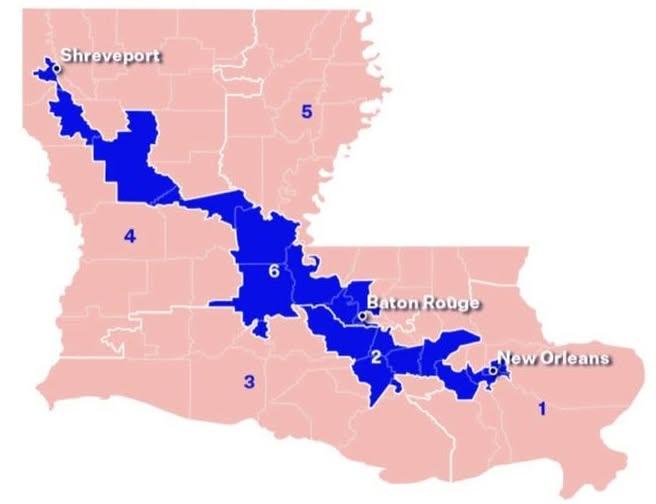
The 2nd and 6th districts (blue) are explicitly racially-gerrymandered districts. But, the recent Supreme Court opinion in Louisiana v. Calais (2026) tells the state that it can redraw its district map with less consideration for explicit racial gerrymandering.
Barack Obama complains that the Supreme Court opinion in Louisiana v. Calais “guts a key pillar in the Voting Rights Act.” (How does one “gut” a “pillar”?)
I would suggest that the Supreme Court opinion does begin to draw some attention to a key pillar of race-based policy making: “disparate impact doctrine.” “Disparate Impact Doctrine” says that a given policy may not be racist per se, but were it to impose a “disparate impact” on a “protected class” of people, then that policy might yet be deemed illegal. So, for example, subjecting candidates for entry level jobs at Chicago fire departments to written exams had been declared illegal in the Supreme Court opinion in Lewis v. Chicago, 560 U.S. 205 (2010), because testing “had a disparate impact on African-Americans in violation of Title VII of the Civil Rights Act of 1964.”
In passing, the Court in Louisiana v. Calais notes:
[A] law that seeks to enforce the Fifteenth Amendment by prohibiting mere disparate impact would fail to enforce a right that the Amendment secures… [T]he focus of §2 [of the Voting Rights Act] must be enforcement of the Fifteenth Amendment’s prohibition on intentional racial discrimination... In short, §2 imposes liability only when the evidence supports a strong inference that the State [of Louisiana] intentionally drew its districts to afford minority voters less opportunity [to vote] because of their race.
So, redrawing districts “on nonracial factors” does not preclude anyone, black or white or other, from voting! And the VRA does not obviously require states to craft districts in accordance with racial criteria. But the ghost of Jim Crow!
The recent referendum in the state of Virginia involves this proposed gerrymander:
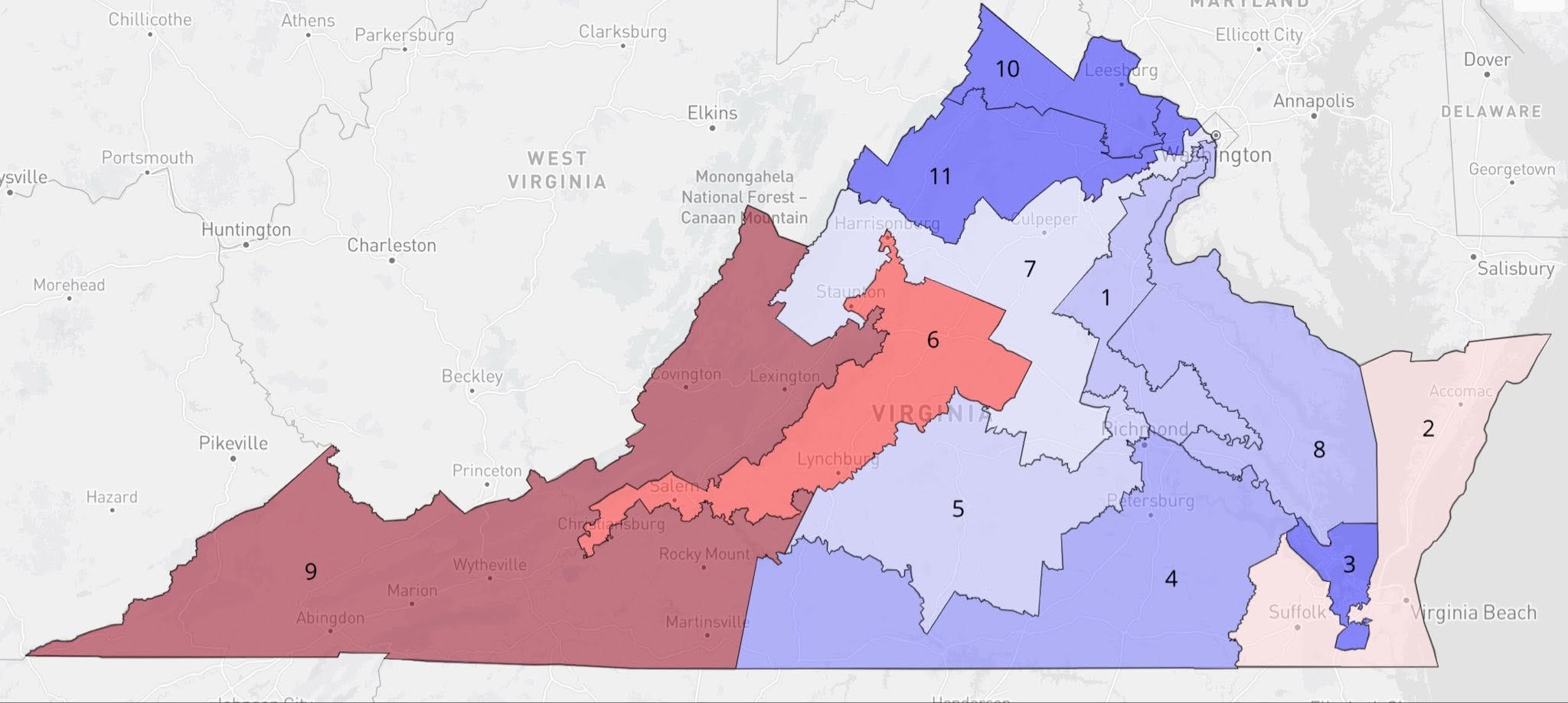
This gerrymander is less obviously motivated by race, but it does anchor four of eleven proposed districts in Fairfax County. Fairfax County lies right outside of Washington, DC and is heavily populated with constituents that tend to heavily favor Democrats over Republicans. Those constituents include a lot of Federal Government employees as well as a lot of foreign-born residents. A lot of Vietnamese people live in that area—and they tend to favor Republicans—but everyone else (Indians, Koreans, Chinese, Central Americans, South Americans, Middle Easterners, Africans) tend to heavily favor Democrats.
The purpose of the map is to flip Virginia’s representation in Congress from “6-to-5” (6 Democrats and 5 Republicans) to “10-to-1” with Republicans likely only prevailing in (the Burgundy colored) district 9. Virginia state senator Louise Lucas has loudly, proudly and frequently framed the matter as “Ten Fuckin’ One”:


Our Democracy™ at work!
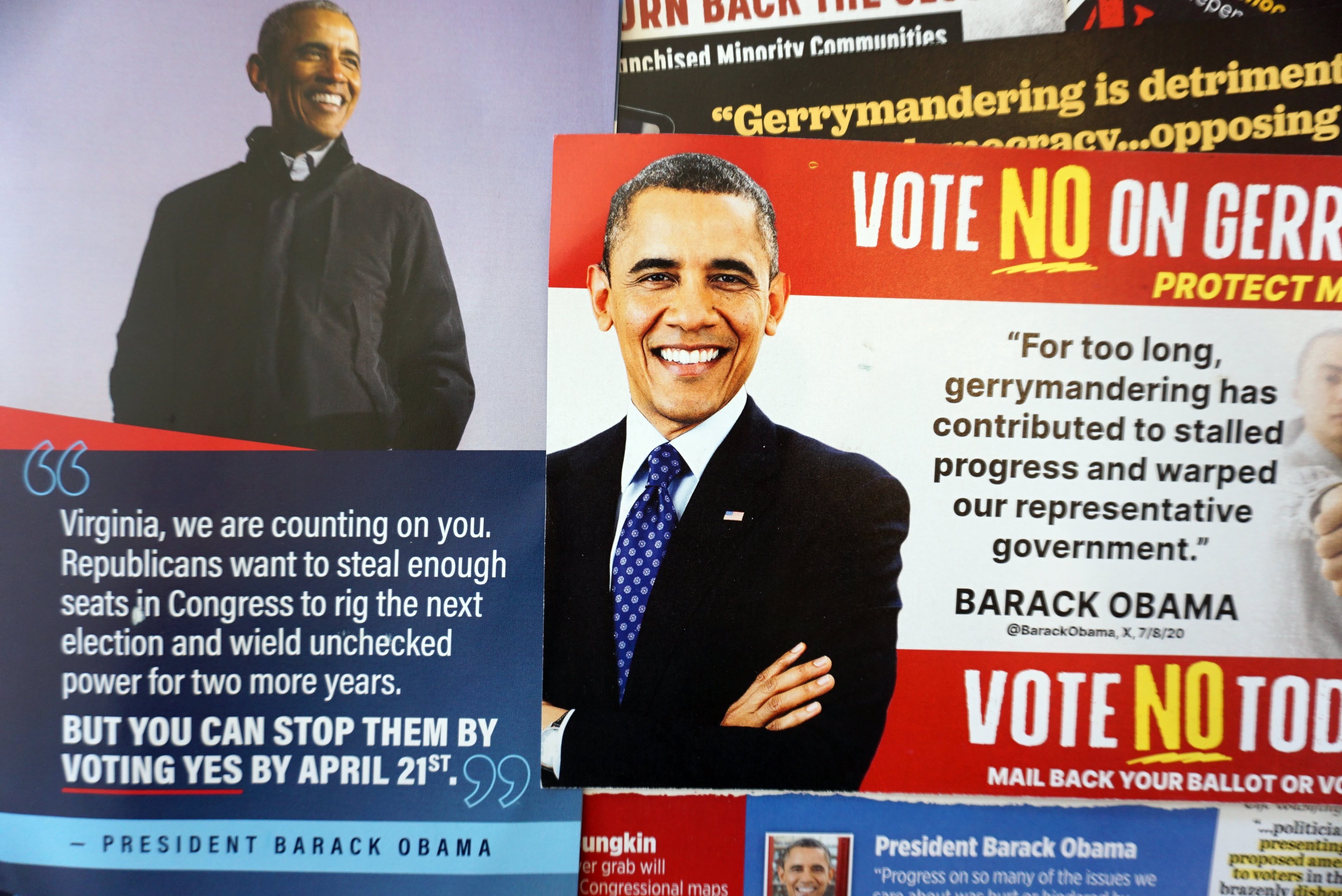
As I reported in my last essay, Barack Obama supports this proposed 10-to-1 gerrymander notwithstanding the fact that, when it suits his purposes, he will complain about gerrymandering.
His rhetoric conforms to his usual Obama Two-step: Say something reasonable to draw in the Mid-Wits while using the next breath to declare something entirely contrary to what he just said.
Here’s an example from the mailers that showed up in my mailbox:
What to make all of this gerrymandering business? Can’t states simply commit to “non-partisan” processes that yield compact-ish maps?
Well, yes, they can. And Virginia had committed to just that in 2020, which is what makes this latest gerrymandering ploy likely to be deemed illegal. (We await the less-than-courageous Virginia Supreme Court to either weigh in or decline to weigh in and allow lower court injunctions against implementation of the proposed redistricting to stand.)
Some observers complain that the states of the United States are now falling in to a high-gerrymandering equilibrium. We get it, but some observers note that many states appear to have long been gerrymandered. Why, for example, does nary one state of New England (the states east of the Hudson River) support a single Republican representative in Congress notwithstanding the fact that more that well more 40% of voters has supported Donald Trump in the last three elections?
My main proposition here is: The Federal Government itself has aggressively required gerrymandering ever since the Clinton Administration swept in and explicitly started to interpret the Voting Rights Act as requiring racially-gerrymandered districts. The Supreme Court has started to push back on the racialization of everything with opinions like that of Shelby County v. Holder (2013) and Louisiana v. Calais (2026). The proponents of racial politics complain that any rollback of racialization is racist.
What’s really going on is that the proponents of racial gerrymandering perceive it as no more than a means of securing power, and they secure power in order to elevate their favored racial groups over all others.
How do I know this? Because people who, for the last 35 years, have provided expert testimony in court to support racial gerrymandering have explicitly explained this to me. I am thinking principally of J. Morgan Kousser, the author of the magisterial The Shaping of Southern Politics (1973).
I like Morgan, and I learned a lot from him as a graduate student. I never expected to have interest in Southern politics, but being required to sit in his class exposed me to content about which I have found that I have much to say. But, Morgan is a proponent of the Manichaean oppressor-oppressed view of the world.
Lenin would speak of the “exploiters” and the “oppressed” or “Who/Whom” as in “Who exploits whom?” In this Lenin-ized view, the self-anointed Whom-people are charged with forcing those they identify as the Who-people to live and die in the ghettoes and gulags of Whoville. Or, barring that, the Whom-people are charged with putting bullets in the back of the heads of the Who-people. Either way, no Who’s in Whoville shall be granted equal protection under the law.
These people do not, not, not believe in deliberative, democratic process or in equal protection under the law. Which leads me to this:
That democracy is the best, not to mention the only legitimate, form of government is undoubtedly the most vigorously asserted and least examined political opinion of our day.
That is how Delba Winthrop opens Aristotle: Democracy and Political Science (2019).
One may agree or disagree with any one dimension of that proposition, but we get it.
We also get that the proposition requires a lot of motivation. Like, whaddya mean by “Democracy”? Are we talking about Our Democracy™, which stands in for the political monopoly of a class of self-anointed Best-and-brightest technocrats who codify and then dictate what they believe are the uniquely correct policies? And, as far as I can tell, what makes their governing “democratic” is the uniquely correct bit: only someone who is either misinformed, stupid, or just plain corrupt would resist implementation of the correct policies. Cue Rousseau on “Censorship” in Section VII of Book IV in The Social Contract: Resisting the correct policies is anti-demos, anti-democratic. Or cue Rousseau’s most prominent American disciple, Woodrow Wilson, in “The Study of Administration” (1887): Constitutionally-ordered representative government had subordinated the business of running the country to “public opinion.” Better it would be to liberate the “Bureaucracy” from “the common political life of the people,” Because Progress!
For Progressives, politics is something you have to put up with. It’s the messy business of getting along with the misinformed, the stupid and the corrupt all while trying to finesse one’s way into securing political monopoly. Which brings us back to this business of gerrymandering.
Gerrymandering, of course, has a long history. The neologism “gerrymander” was new (“neo”) as of the redrawing of state senate election districts in Massachusetts in 1812. This was during the tenure of Governor Elbridge Gerry. Here’s the infamous “Gerry-mander” cartoon itself from the March 26, 1812 issue of the Boston Gazette:
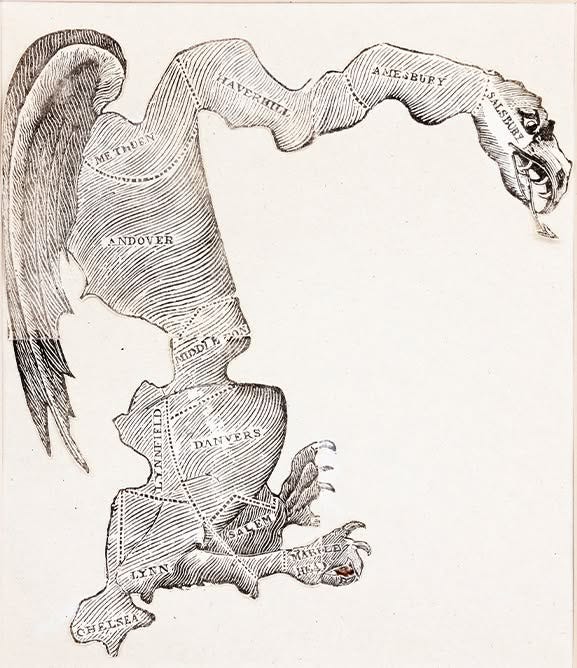
The gerrymander of 1812 inflamed public opinion, because it aggressively redrew districts in Boston. (The “gerrymander” figure grasps the Boston districts in its talons. The other districts do not obviously appear arbitrary.) But, surely, the practice of strategically drawing voting districts pre-dates the 1812 exercise.
Note that in a republic modeled after Plato’s Republic, there would be no concern about gerrymandering, because the Platonic ideal admits no scope for representative government. Plato’s Philosopher Kings (models for the self-anointed Best-and-Brightest) run everything. Aristotle’s Politics, however, concentrated some energy on the fact that society is populated with competing interests. A question then emerges about how to manage those interests. Such questions make it possible to talk about representation: Should everyone in society represent themselves by getting a vote on any given policy matter? Or does everyone get to vote for representatives to whom we delegate some measure of authority to sort out policy questions? Can representative government be unstable in that demagogues may secure representative office and then distort constitutionally-mandated processes going forward? If so, would it better to counter the prospect of the political monopoly of demagogues by instituting something in the spirit of constitutional monarchy?
All I can say for myself is that I am sympathetic to the fact that Aristotle posed questions about how to operationalize “Our Democracy” whereas the actual proponents of Our Democracy™ are really just proponents of their flavor of the totalitarian, Platonic ideal. I would argue that, for all of their messiness, ostensibly “non-partisan” processes have demonstrated some capacity for committing states to compact-ish, actually-representative voting districts, and such non-partisan processes can prevent the Platonists from imposing their dictatorship on the rest of us.
Wonderful article, it clearly lays out how we got to “here” … and by the way, check out the 4th Congressional District of Illinois.